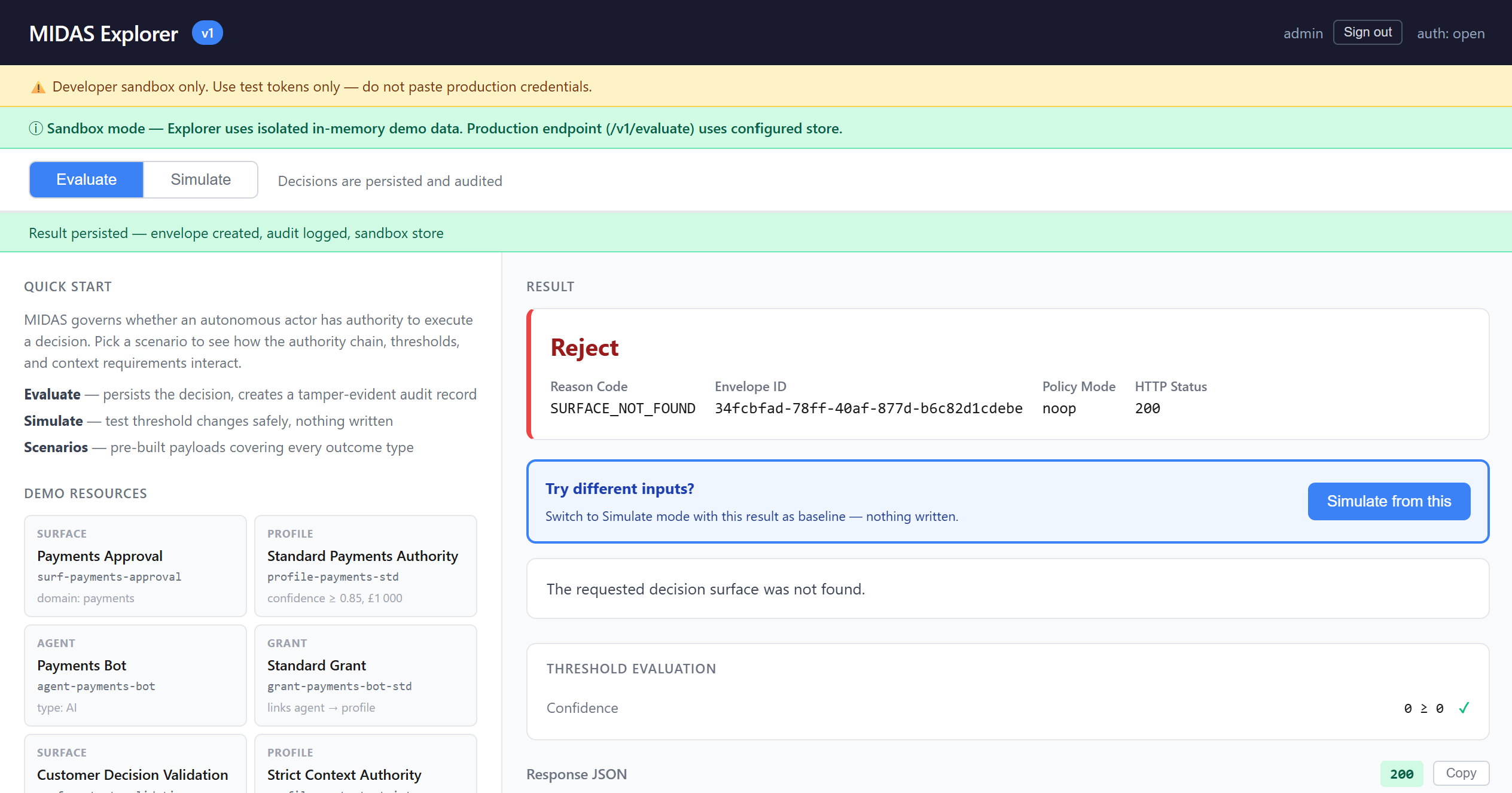

See MIDAS in action
See how MIDAS evaluates and controls decisions before execution.

From decision to governed execution
In most systems, once a decision is made, execution follows automatically. The transition from deciding what should happen to actually performing the action is often implicit. This is where risk is introduced.
MIDAS separates decision from execution. Every action must pass through a governed evaluation before it is allowed to proceed. This ensures that execution is not assumed, but explicitly controlled.
By introducing this boundary, MIDAS creates a consistent point where authority, context, and risk are assessed. The result is a system where actions are not only decided, but governed.
A simple payment example
Consider a payment approval scenario. A system determines that a payment should be made based on predefined rules or a model. Instead of executing immediately, the request is sent to MIDAS for evaluation.
The request defines the payment surface, the agent initiating the action, and the relevant context such as amount and confidence. MIDAS evaluates whether the agent has the authority to perform this action under the given conditions.
If the request is allowed, execution proceeds. If it is rejected, the payment is blocked. If it is escalated, the request is routed for further review. The outcome ensures that execution aligns with defined governance.

Consistent evaluation across workflows
The same pattern applies across different systems and workflows. Whether an action originates from a user interface, a backend service, or an automated agent, it is evaluated using the same structured process.
This removes the need for each system to implement its own control logic. Instead, MIDAS provides a shared governance layer that ensures consistent enforcement of authority and constraints.
As systems scale and become more interconnected, this consistency becomes critical. It allows organisations to maintain control without introducing fragmentation or complexity.
Making execution observable
One of the key benefits of MIDAS is visibility. Every governed action is evaluated in a way that can be observed and understood. Outcomes are not hidden within system logic but exposed as part of a structured process.
This makes it possible to trace how decisions lead to actions and how those actions are controlled. It also enables teams to identify patterns, investigate issues, and improve governance over time.
Execution becomes something that can be monitored and reasoned about, rather than assumed.
From isolated checks to unified controls
Without a governance layer, systems often rely on scattered checks embedded across services. These checks may vary in quality, consistency, and visibility. Over time, this leads to gaps in control and increased risk.
MIDAS replaces these fragmented approaches with a unified model. Every action is evaluated in the same way, using the same concepts and structure. This simplifies how governance is implemented and maintained.
By centralising control at the point of execution, MIDAS ensures that governance is applied consistently across all systems.
Building a governed system
Seeing MIDAS in action is about understanding how this model fits into real environments. It is not a separate workflow, but an integrated layer that sits between decision and execution.
As you begin to apply this pattern, start with a small number of actions and expand gradually. Focus on areas where control, auditability, and consistency are most important.
Over time, this approach transforms how systems operate. Decisions are no longer isolated events, but part of a governed process that ensures every action is controlled, explainable, and accountable.

Explore how MIDAS evaluates decisions and governs execution across real-world scenarios, ensuring actions are controlled before they are performed.
Stay up to date with Accept Labs
Insights, experiments, and new capabilities from Accept Labs — delivered as they emerge.