
What is a governance envelope?
Discover how governance envelopes capture and secure the full evaluation of every action.

Introduction to audit and accountability
In many systems, audit is treated as a secondary concern. Logs are generated after actions are performed, capturing what happened but not necessarily how or why it happened.
As systems become more autonomous, this approach becomes insufficient. Understanding outcomes requires more than a record of events. It requires a structured representation of the evaluation process itself.
The governance envelope provides this structure.
Beyond traditional logging
Traditional logs capture events as they occur, often in isolation. While useful for debugging, they do not provide a complete picture of how a decision was evaluated or how an outcome was reached.
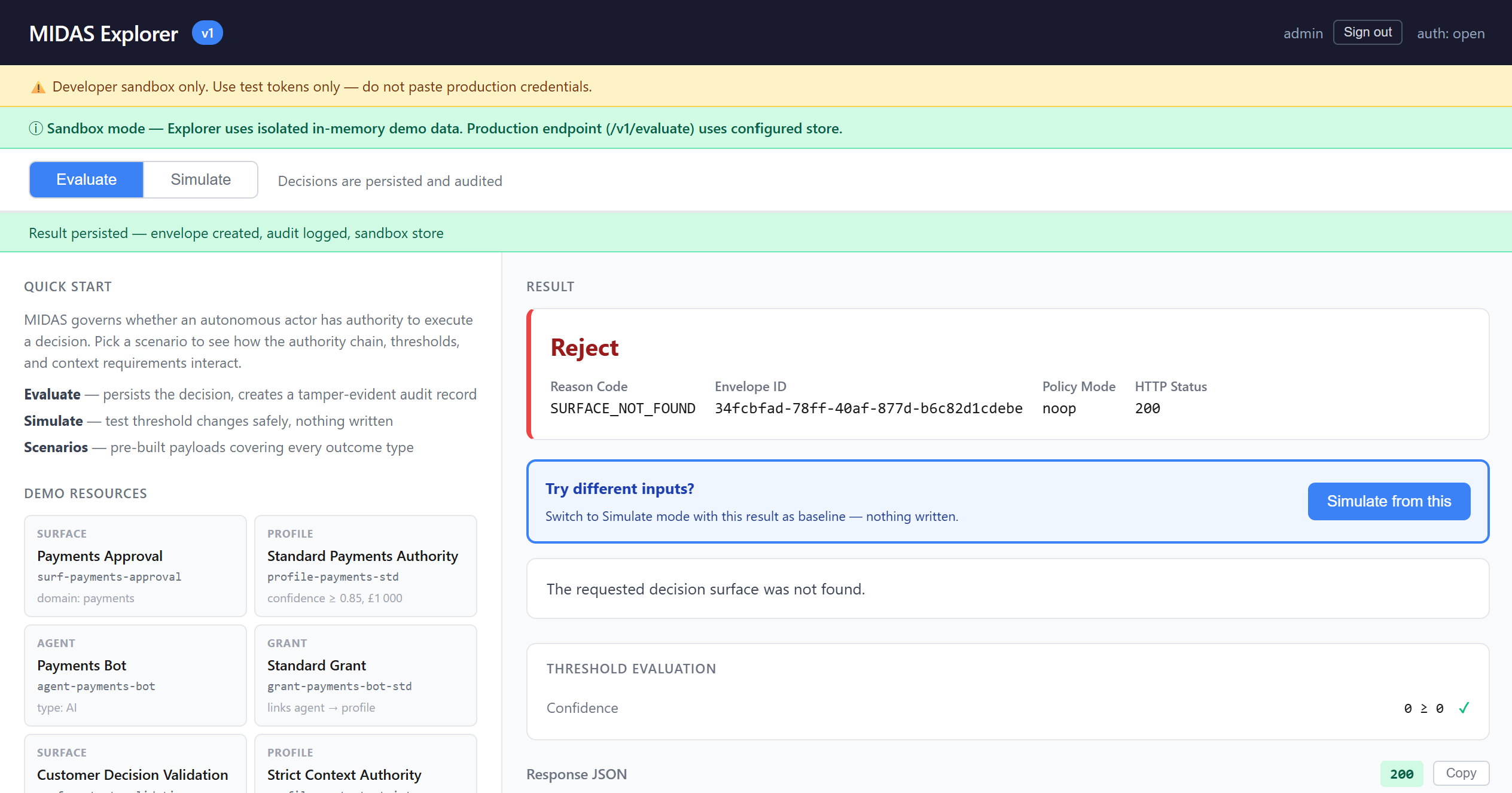
A governance envelope is different. It captures the full evaluation of a request, including the inputs, the steps taken, and the final outcome. This creates a complete and coherent record.

A tamper-evident record
Each governance envelope is designed to be tamper-evident. The sequence of events within the evaluation is linked in a way that allows integrity to be verified.
This ensures that the record cannot be altered without detection. It provides a level of trust that is critical for systems where accountability matters.
Linking decisions to outcomes
The envelope connects the original request to the governed outcome. It shows how the request was processed, what checks were performed, and why a particular result was produced.
This makes it possible to trace actions back to their origin and understand the reasoning behind them.
Building trust in execution
By producing a governance envelope for every evaluation, MIDAS ensures that actions are not only controlled but also provable. This creates a foundation for trust in how systems operate.
Over time, these envelopes form a continuous record of governed execution, enabling organisations to demonstrate control, investigate issues, and improve their governance models.

Stay up to date with Accept Labs
Insights, experiments, and new capabilities from Accept Labs — delivered as they emerge.